
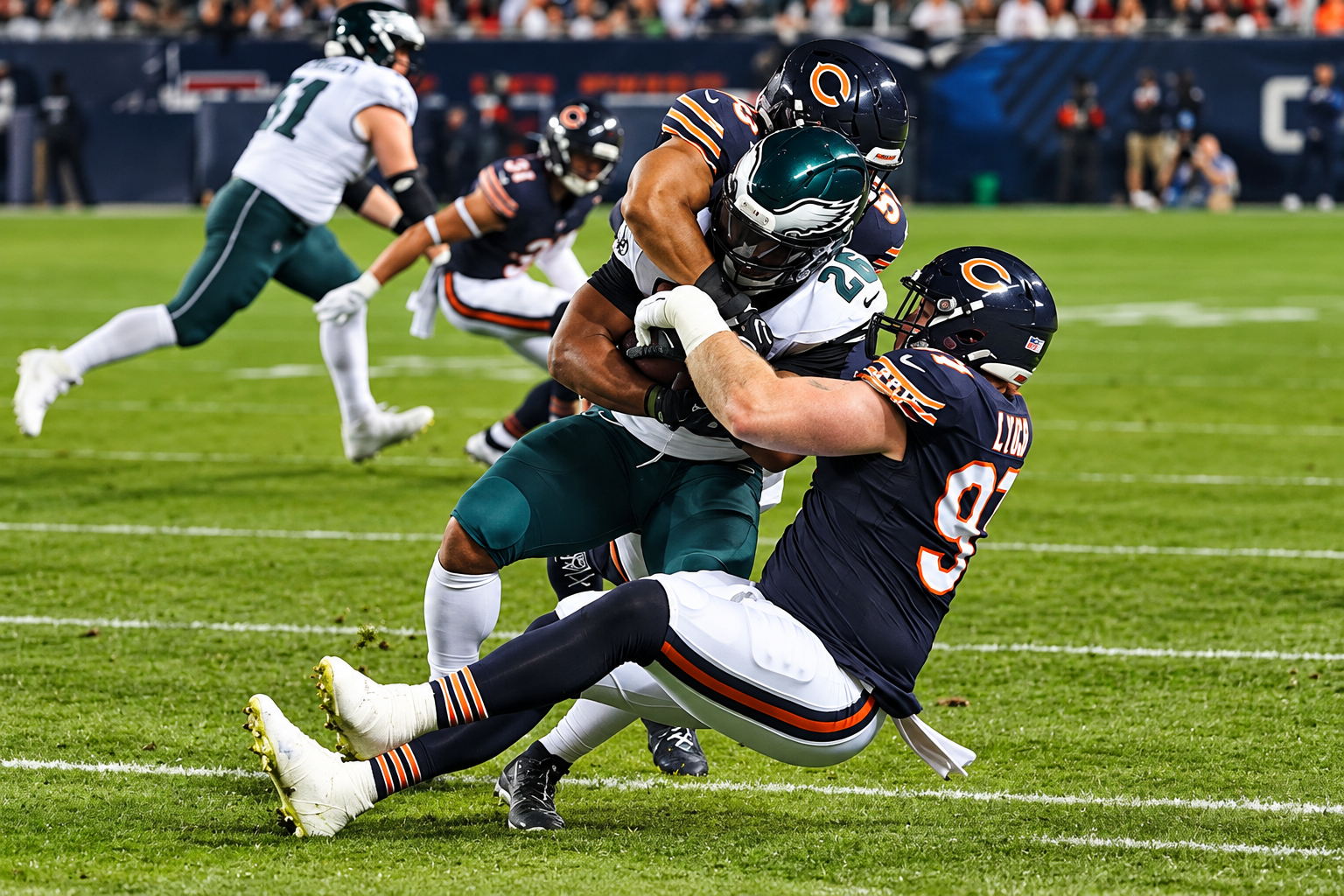
The Chicago Bears did not need their starting quarterback to produce one of the most convincing performances of Week 3. With Caleb Williams sidelined by a hamstring injury, 38-year-old Case Keenum stepped into the lineup Monday night and helped Chicago beat the Philadelphia Eagles 27-7 at Soldier Field.
Keenum was not supposed to be the headline of Chicago’s season. He entered the week as the Bears’ third quarterback, with backup Tyson Bagent only recently cleared from concussion protocol. But in his first regular-season action since 2023, Keenum played like a quarterback who had been waiting for exactly this kind of opportunity. He completed 24 of 34 passes for 247 yards, threw two touchdowns and added a rushing score, finishing with a 110.8 passer rating.
Chicago set the tone immediately. Keenum directed an 11-play, 66-yard opening drive and finished it with an 8-yard touchdown pass to rookie receiver Luther Burden III. Instead of playing conservatively around a veteran backup, the Bears let Keenum operate the offense, distribute the ball and attack Philadelphia’s coverage.
That approach mattered because the Eagles never found control of the game. Philadelphia entered the night with the talent to pressure a backup quarterback, but Chicago repeatedly stayed ahead of the chains and protected Keenum well enough for him to make quick, decisive throws. Kalif Raymond became one of his biggest targets, catching six passes for 90 yards, including a 41-yard touchdown in the second half that gave the Bears breathing room.
The larger story, though, was Chicago’s defense.
The Bears forced three turnovers and kept Philadelphia from developing sustained momentum. Austin Booker knocked the ball loose from Tank Bigsby on a short reception, and Xavier Woods recovered the fumble deep in Eagles territory. Later, rookie safety Dillon Thieneman intercepted backup quarterback Andy Dalton in the end zone after Jalen Hurts briefly left the game to be evaluated for a concussion.
Hurts returned, but Philadelphia’s offense never fully recovered its rhythm. The Eagles managed only 62 total yards in the second half and opened the third quarter with three consecutive three-and-outs. Chicago also held Philadelphia to two conversions on nine third-down attempts, repeatedly forcing the Eagles off the field before they could build momentum.
Philadelphia’s best stretch came late in the second quarter. After Chicago settled for a Cairo Santos field goal, the Eagles drove 62 yards and Hurts scored on a 1-yard quarterback sneak as time expired in the half. That cut Chicago’s lead to 10-7 and made the game look competitive going into halftime.
The second half changed that quickly.
Chicago’s defense forced another stop, Santos connected from 48 yards, and Keenum followed with the 41-yard touchdown strike to Raymond. Suddenly the Bears were up 20-7, and Philadelphia was chasing a game that had already started slipping away.
Linebacker T.J. Edwards delivered another major swing late in the third quarter when he intercepted Hurts on fourth down. The Bears then put together a 13-play drive that drained more than eight minutes from the clock. Keenum finished the possession himself with a 1-yard touchdown run, pushing the score to 27-7 with just over seven minutes remaining.
By the end of the night, the numbers reflected the difference in execution. Chicago outgained Philadelphia 375-248 and controlled the ball for nearly 37 minutes. The Eagles committed 10 penalties and turned the ball over three times. Saquon Barkley still produced 82 rushing yards and DeVonta Smith caught six passes for 65 yards, but those individual numbers never became enough sustained offense to threaten Chicago.
The result was especially striking because of the circumstances surrounding Keenum. He had not started an NFL game since December 2023, yet Chicago did not look like a team trying to survive with an emergency option under center. The Bears looked prepared to run their offense, and Keenum rewarded that trust with efficient decisions and three total touchdowns.
For Chicago, the win also represented a response. The Bears had been held to three points in a Week 2 loss to Minnesota. Seven days later, they produced 27 points, protected the football and leaned on a defense that became more dominant as the game continued.
For Philadelphia, the loss was less about one bad stat and more about how many problems arrived at once. Penalties stalled possessions. Turnovers erased opportunities. Hurts was pressured into mistakes. Even when the Eagles moved the ball, they struggled to finish drives. A team with postseason expectations now has an early reminder that talent does not protect against poor execution.
Both teams left Week 3 at 2-1, but they walked away with very different feelings. Chicago discovered that its offense can function with Keenum if Williams needs more time to recover. Philadelphia left with questions about discipline, ball security and how quickly its offense can regain consistency.
The score says 27-7. The bigger message was that Chicago controlled the night from the opening drive through the final minutes — and did it with a quarterback almost nobody expected to be the story.